CS180 — Project 1: The Prokudin-Gorskii Collection
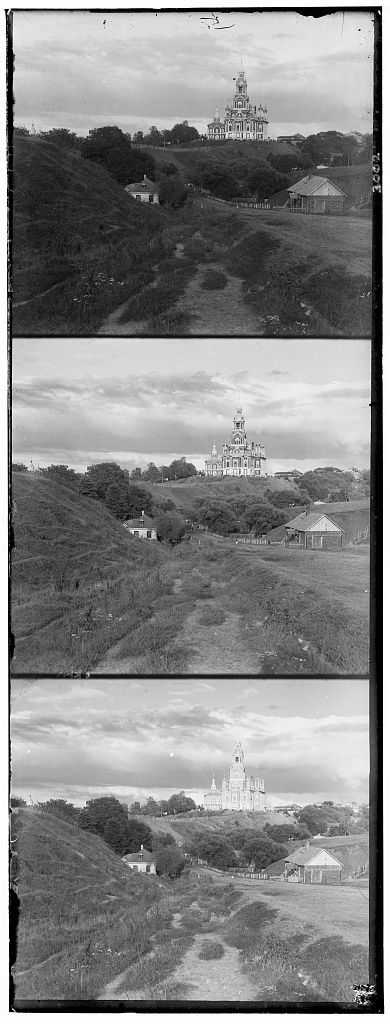
This project focuses on the digitized glass plate images from Sergei Prokudin-Gorskii, a pioneer of color photography. His technique involved capturing three monochrome images of a scene in quick succession, each through a different color filter (red, green, and blue). Our task is to take these separated channels and align them to reconstruct the original color photograph.
Naive Channel Overlay
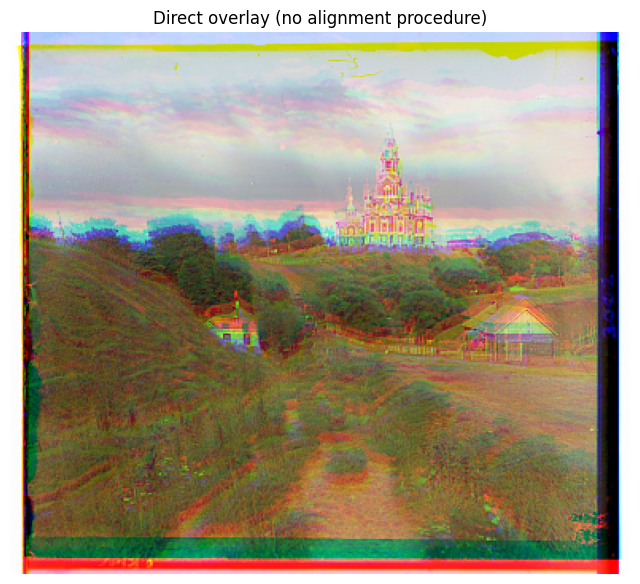
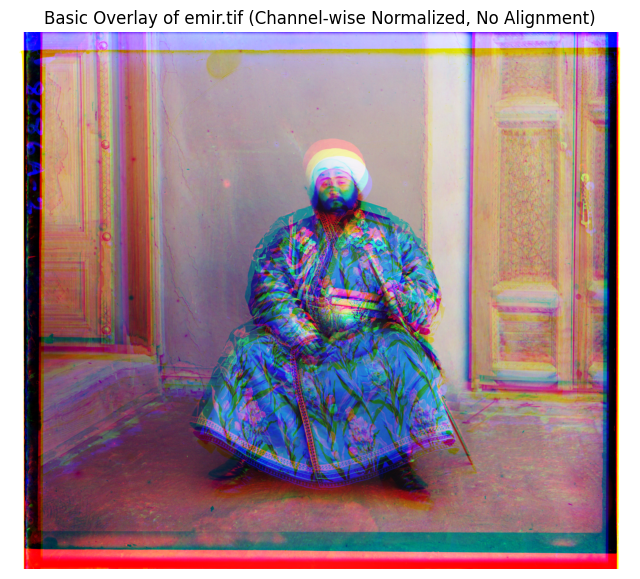
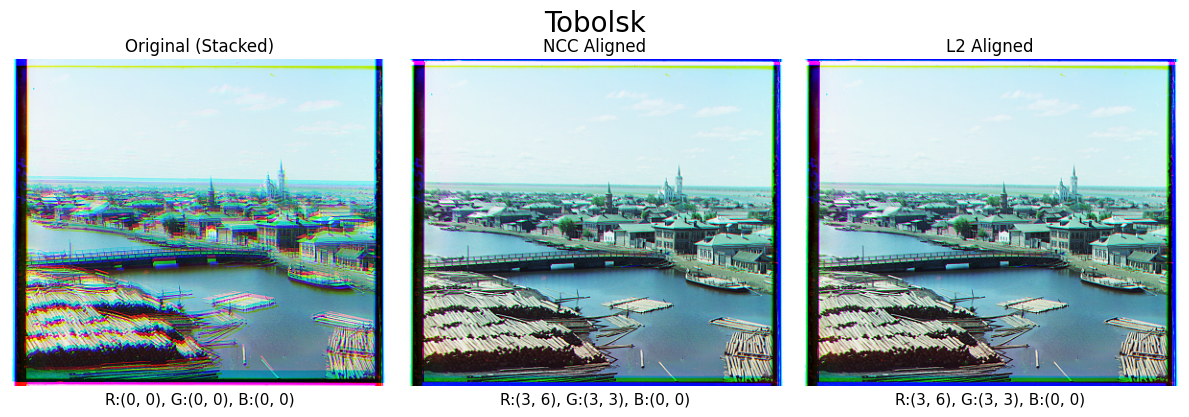
The simplest approach to creating a color image is to split the three channels and directly stack them. However, because the plates were captured separately, they are almost always misaligned. This naive overlay results in significant color fringing and a blurry, distorted image.
Single-Scale Alignment
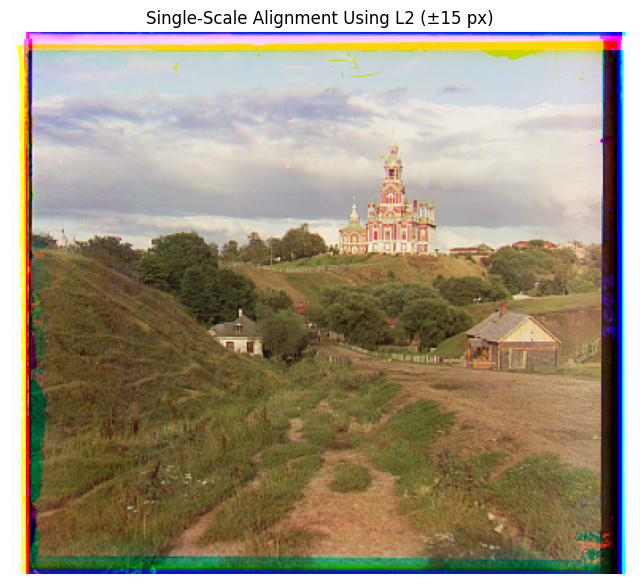
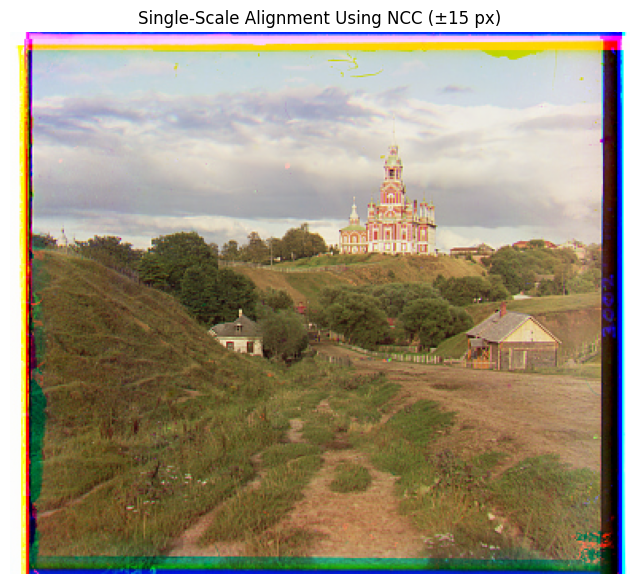
To fix the misalignment, we can use a single-scale alignment algorithm. This method performs an exhaustive search over a small pixel window, shifting one channel relative to a reference channel. The best alignment is the displacement that maximizes the similarity between the two channels, according to a chosen distance metric. We use two primary distance metrics:
1. L2 Norm (Sum of Squared Differences): This metric calculates the direct Euclidean distance between the pixel values of two images. It's fast but sensitive to overall brightness differences.
$$ L_2 = \sqrt{\sum_{i=1}^{n}(u_i - v_i)^2} $$
2. Normalized Cross-Correlation (NCC): This metric is more robust to linear variations in brightness and contrast. It normalizes both images before comparing them.
$$ NCC = \frac{1}{n} \sum_{i=1}^{n} \frac{(u_i - \bar{u})}{\sigma_u} \frac{(v_i - \bar{v})}{\sigma_v} $$
Multi-Scale Pyramid Alignment
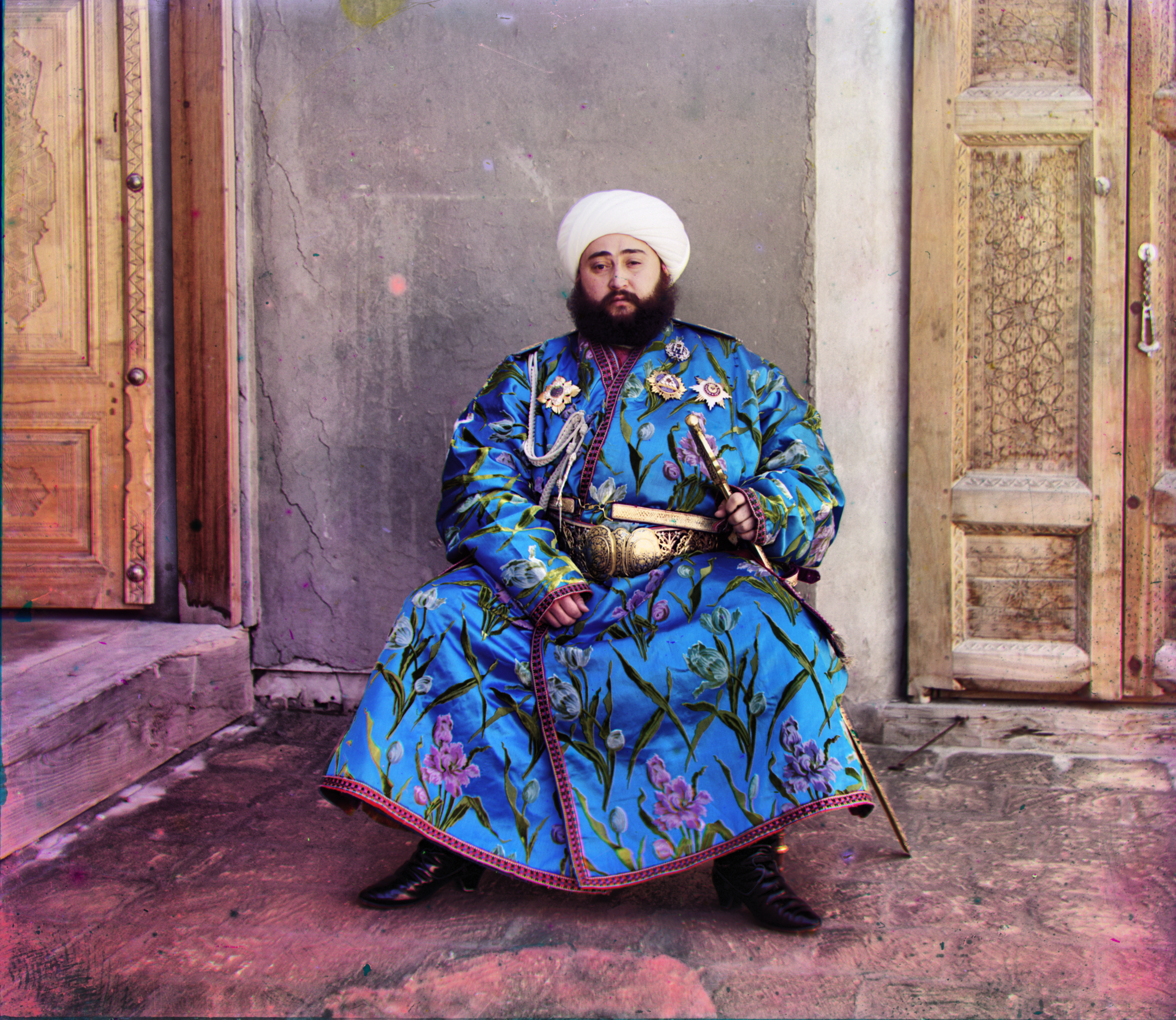
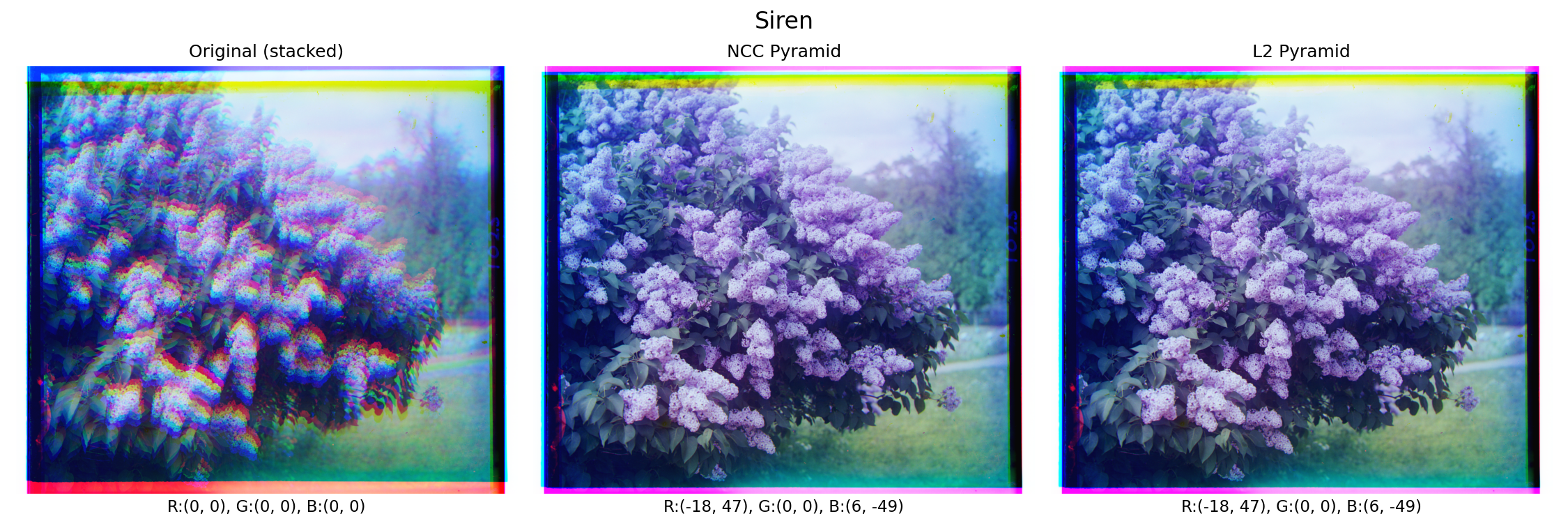
For high-resolution images like emir.tif, an exhaustive search is computationally expensive. A more efficient strategy is the multi-scale image pyramid. This approach creates a series of downsampled images (a pyramid). It first finds a coarse alignment on the smallest image, then refines the search in a small window at progressively higher resolutions. This coarse-to-fine strategy is significantly faster and more effective for large displacements.
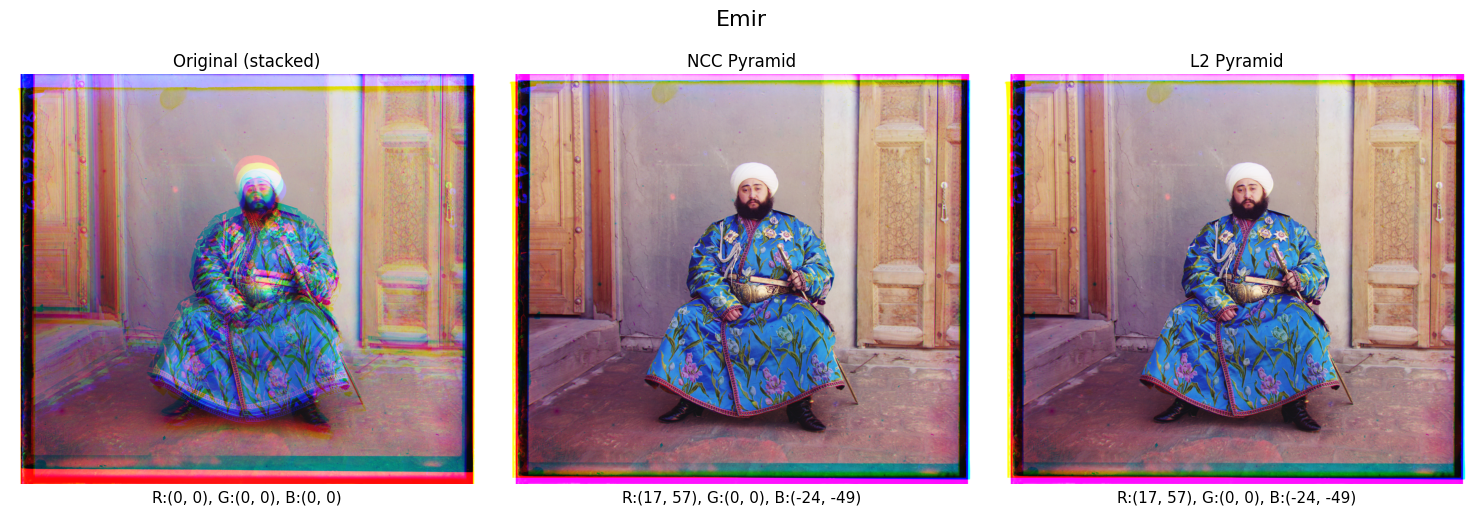
Alignment Gallery
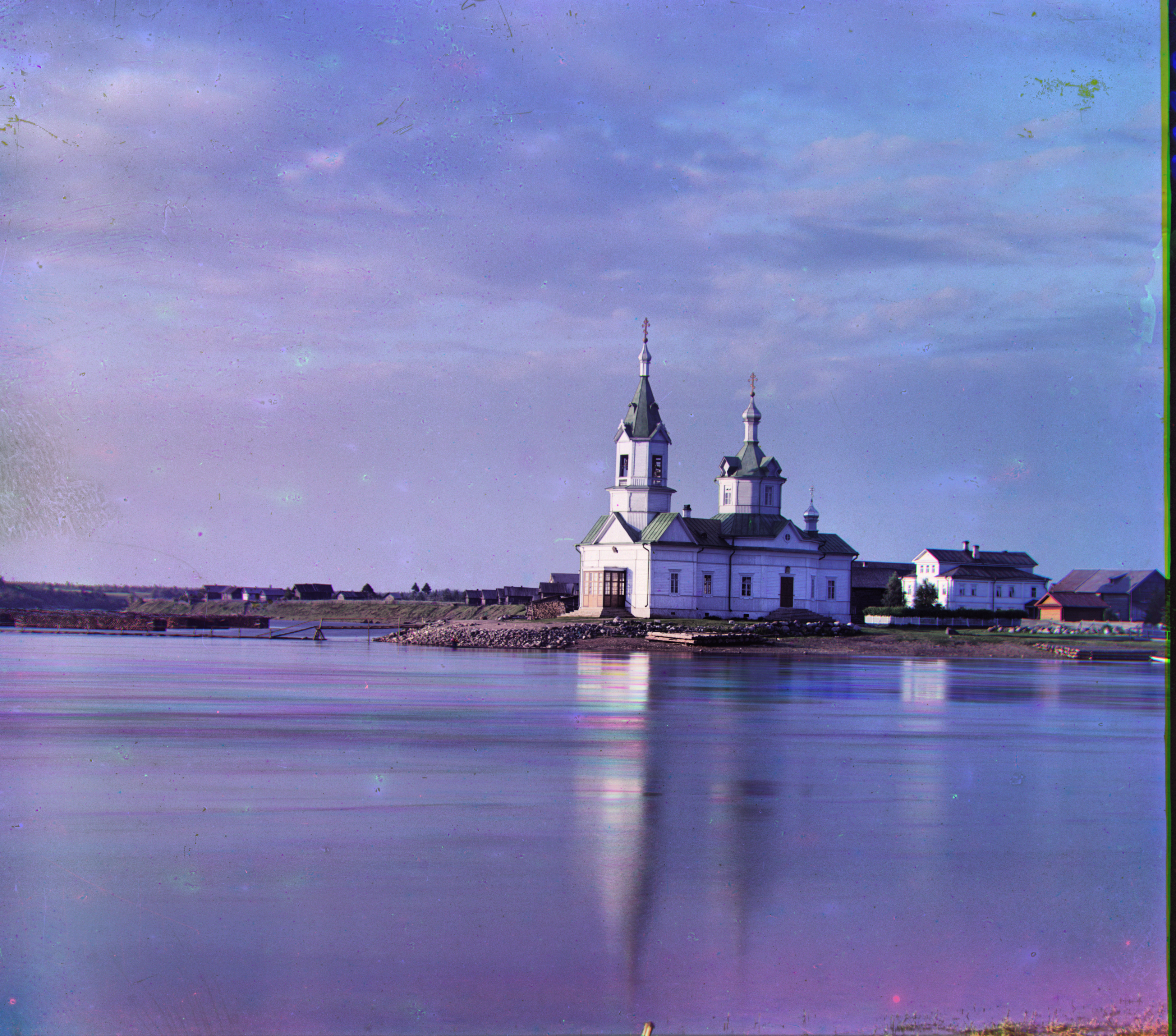
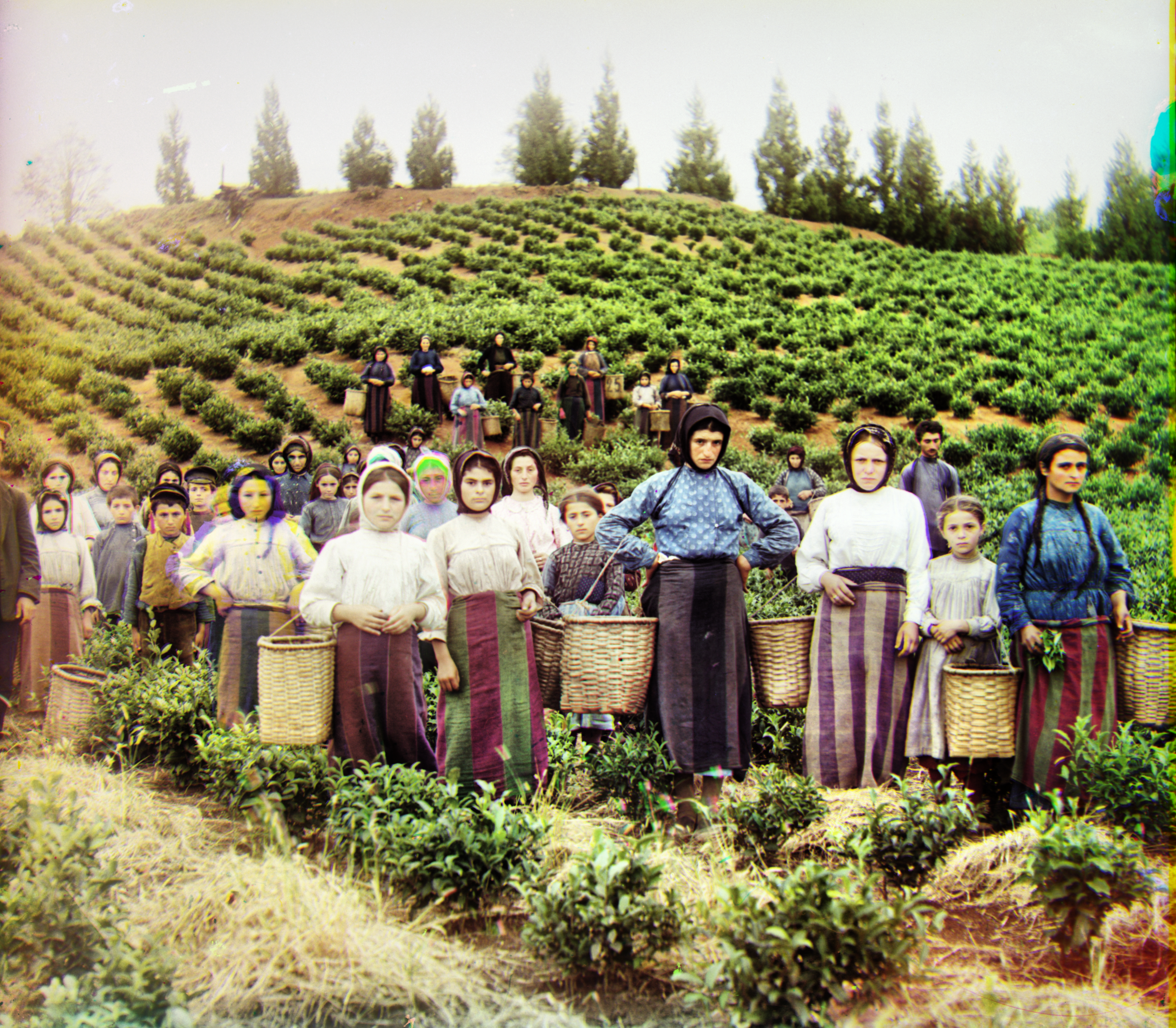
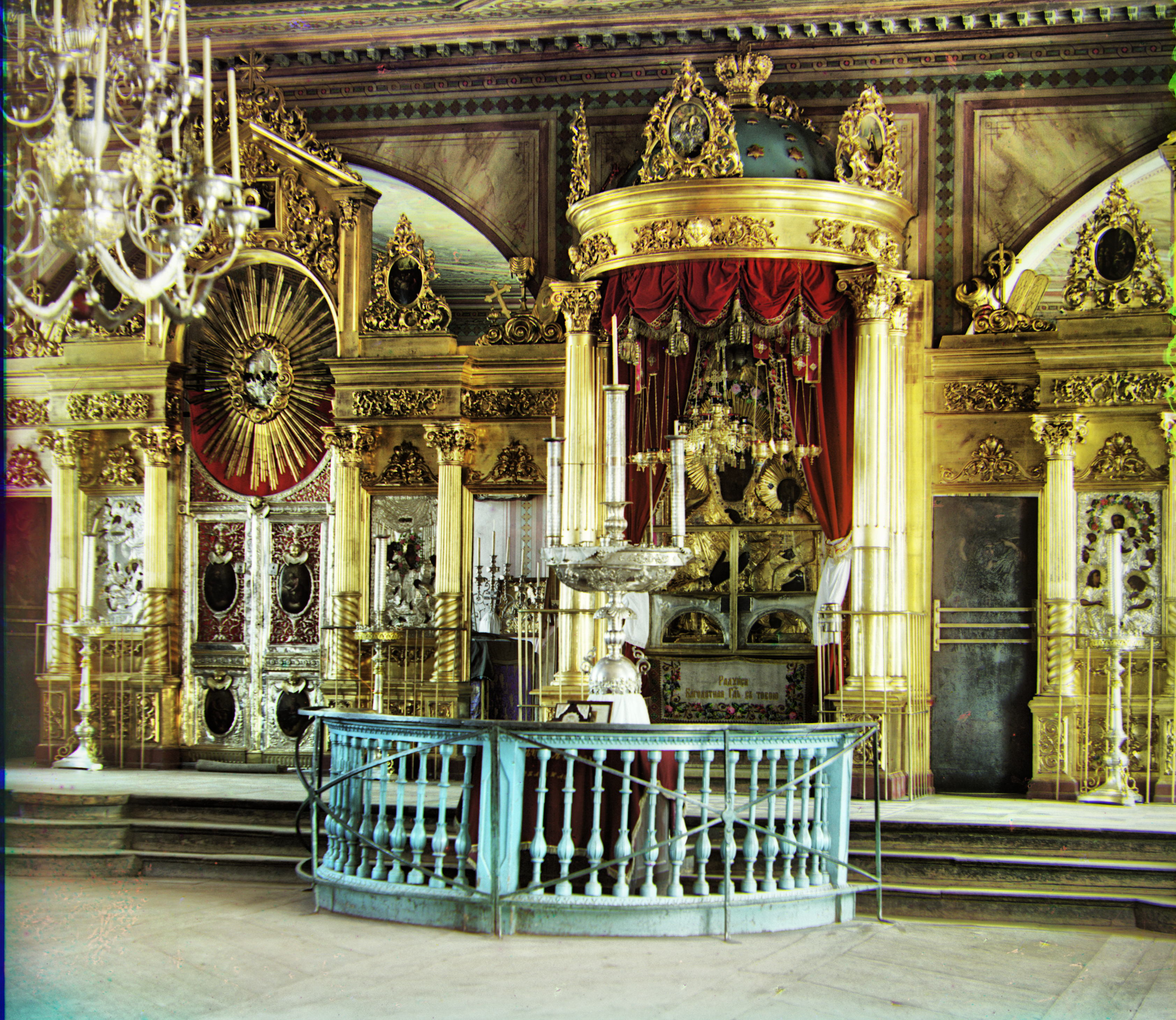
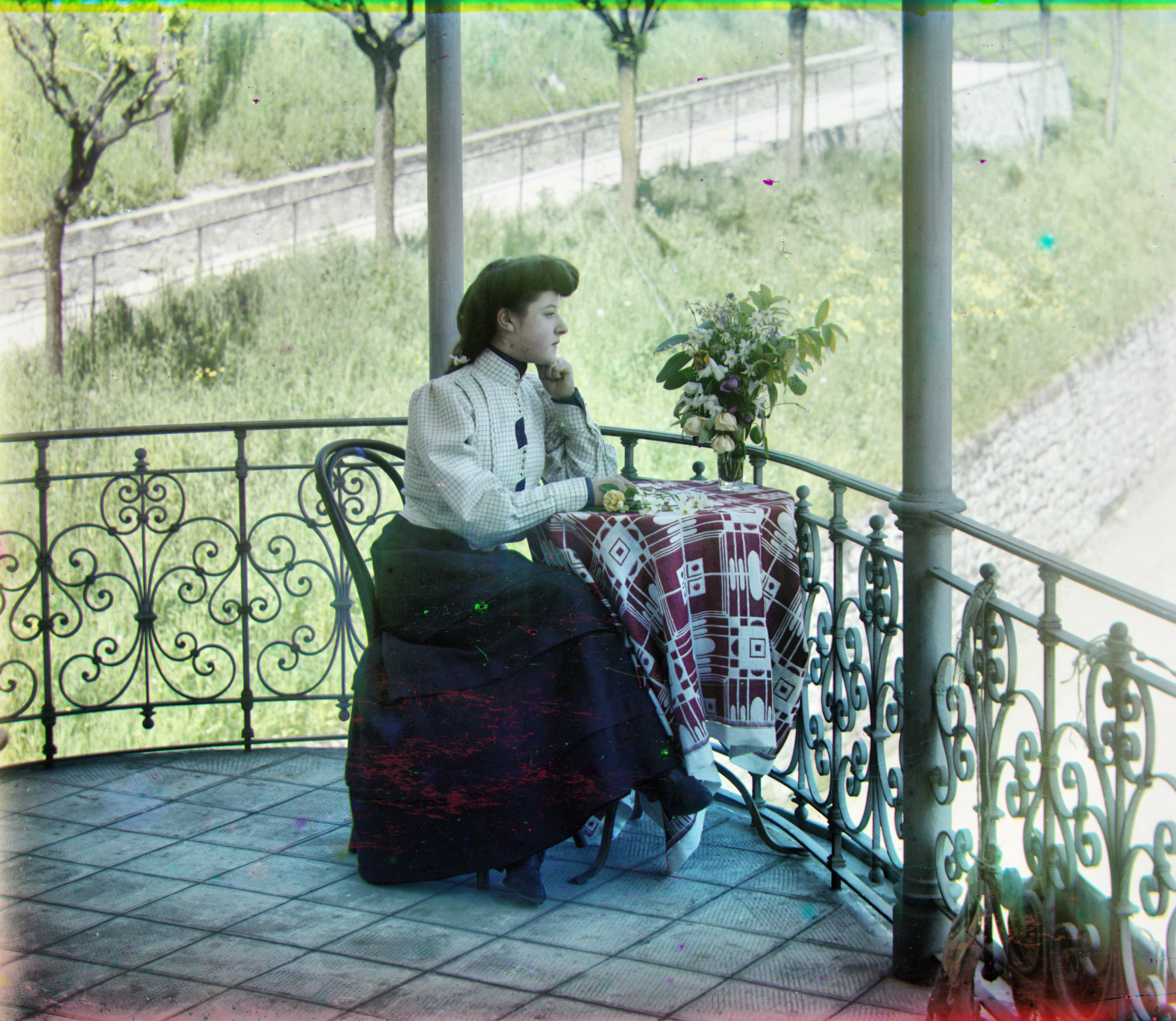
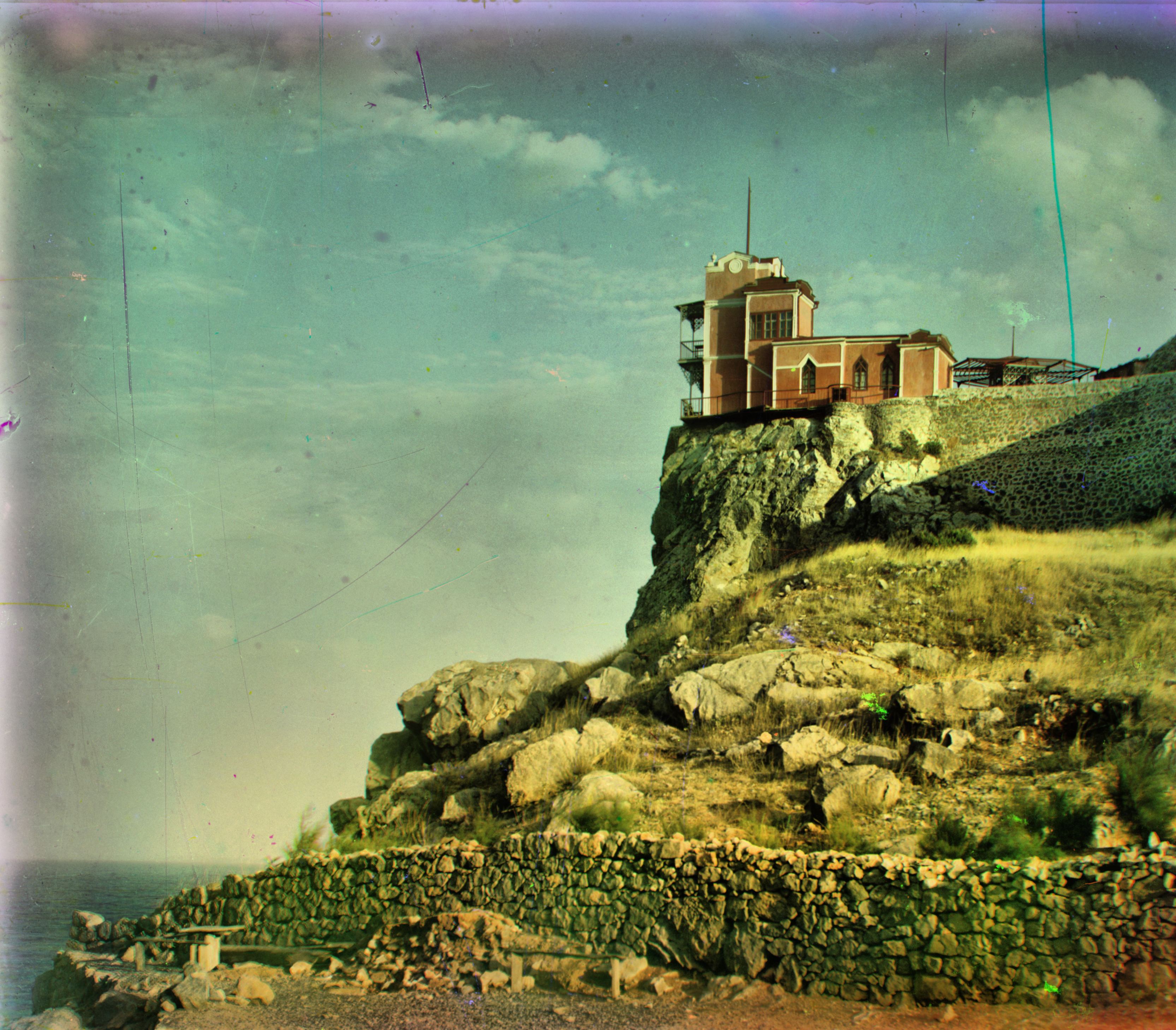
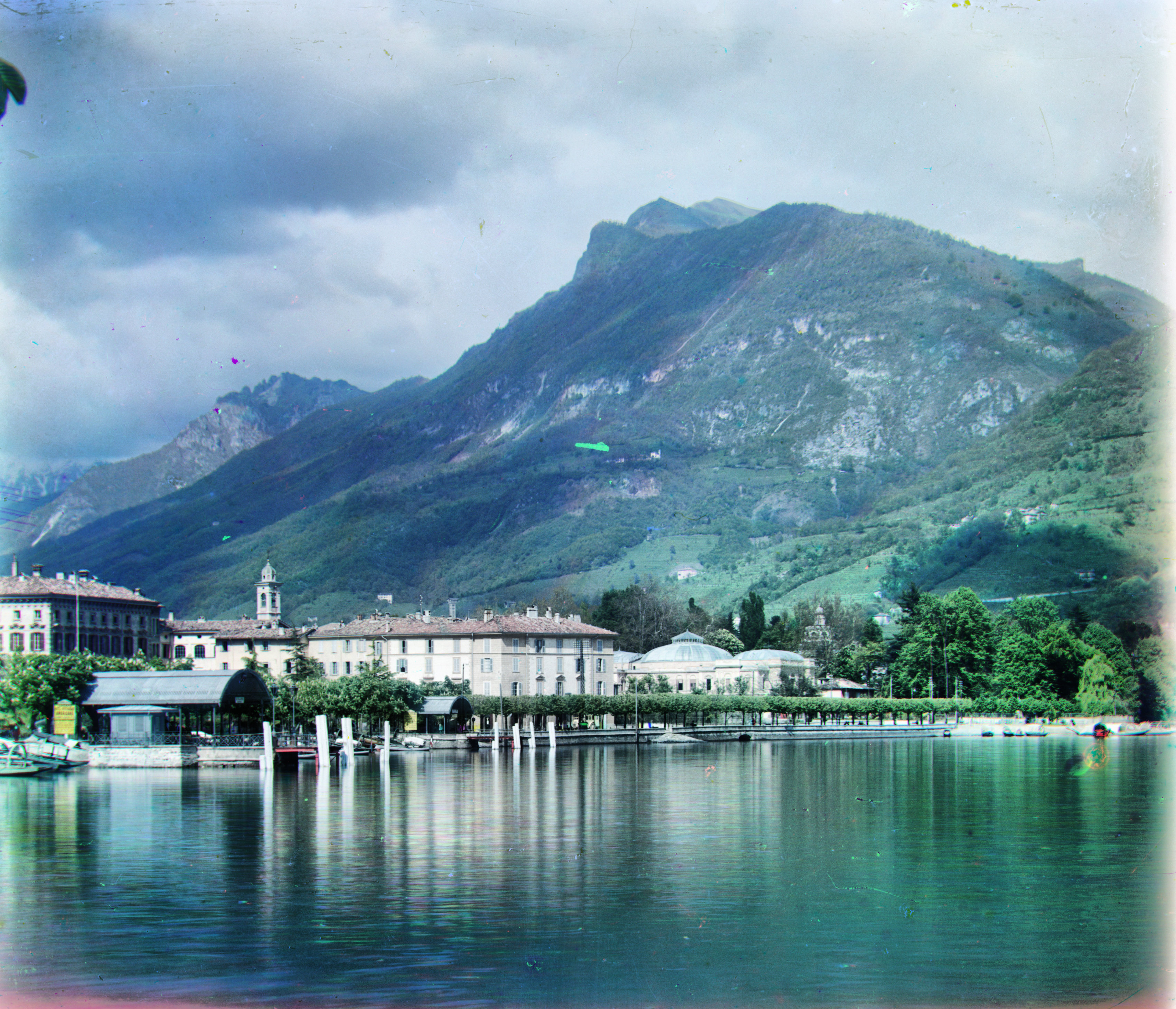
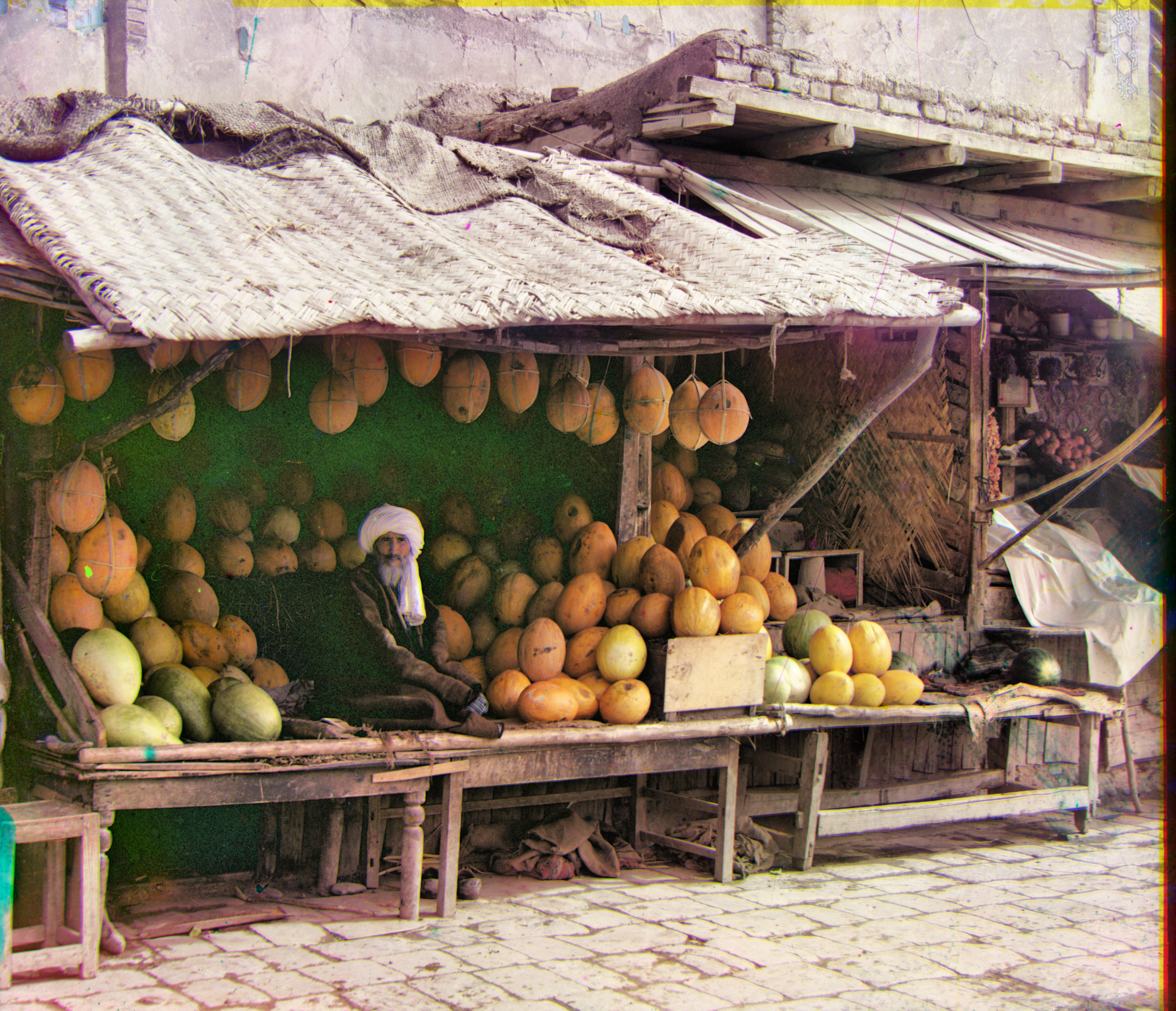
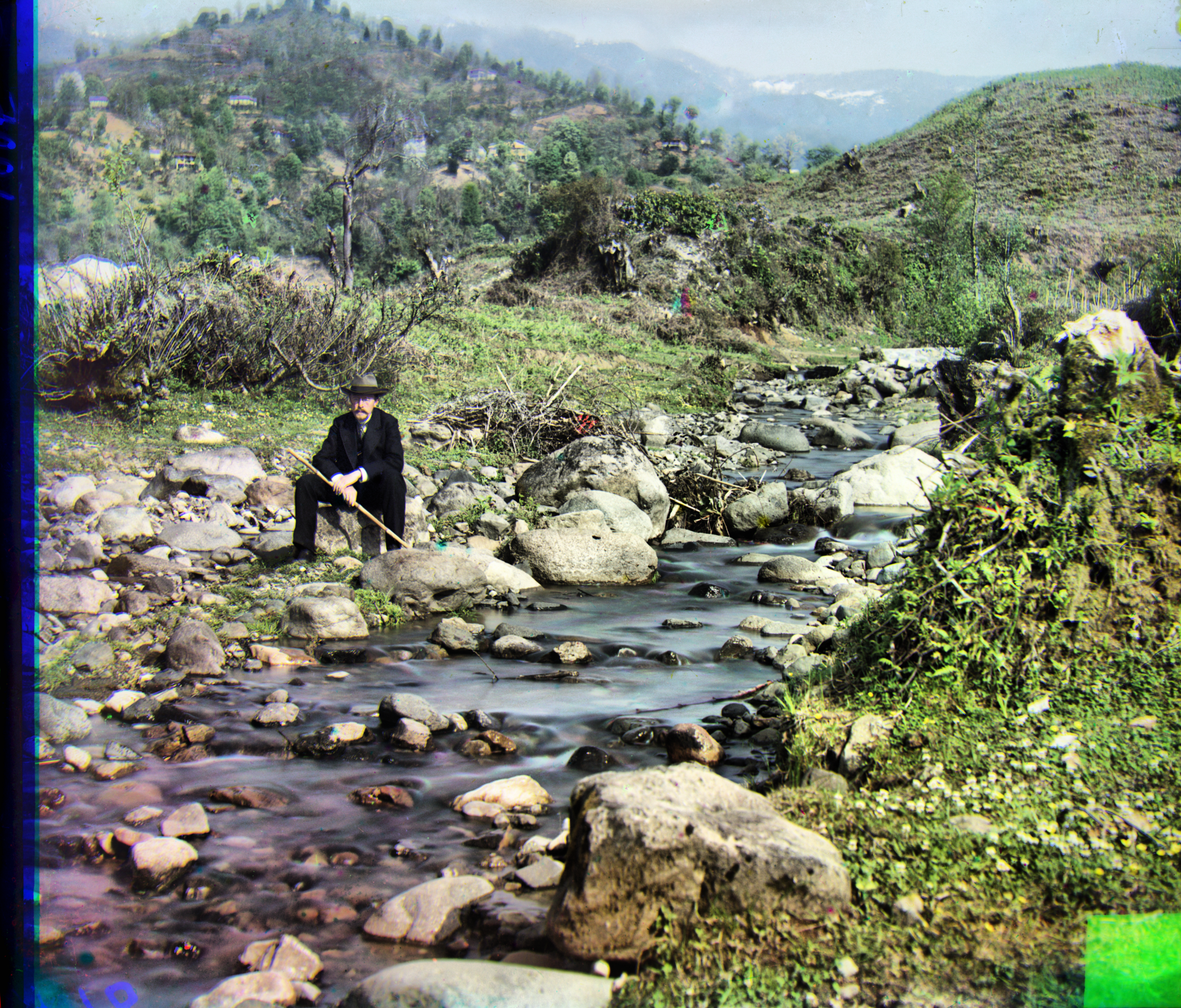
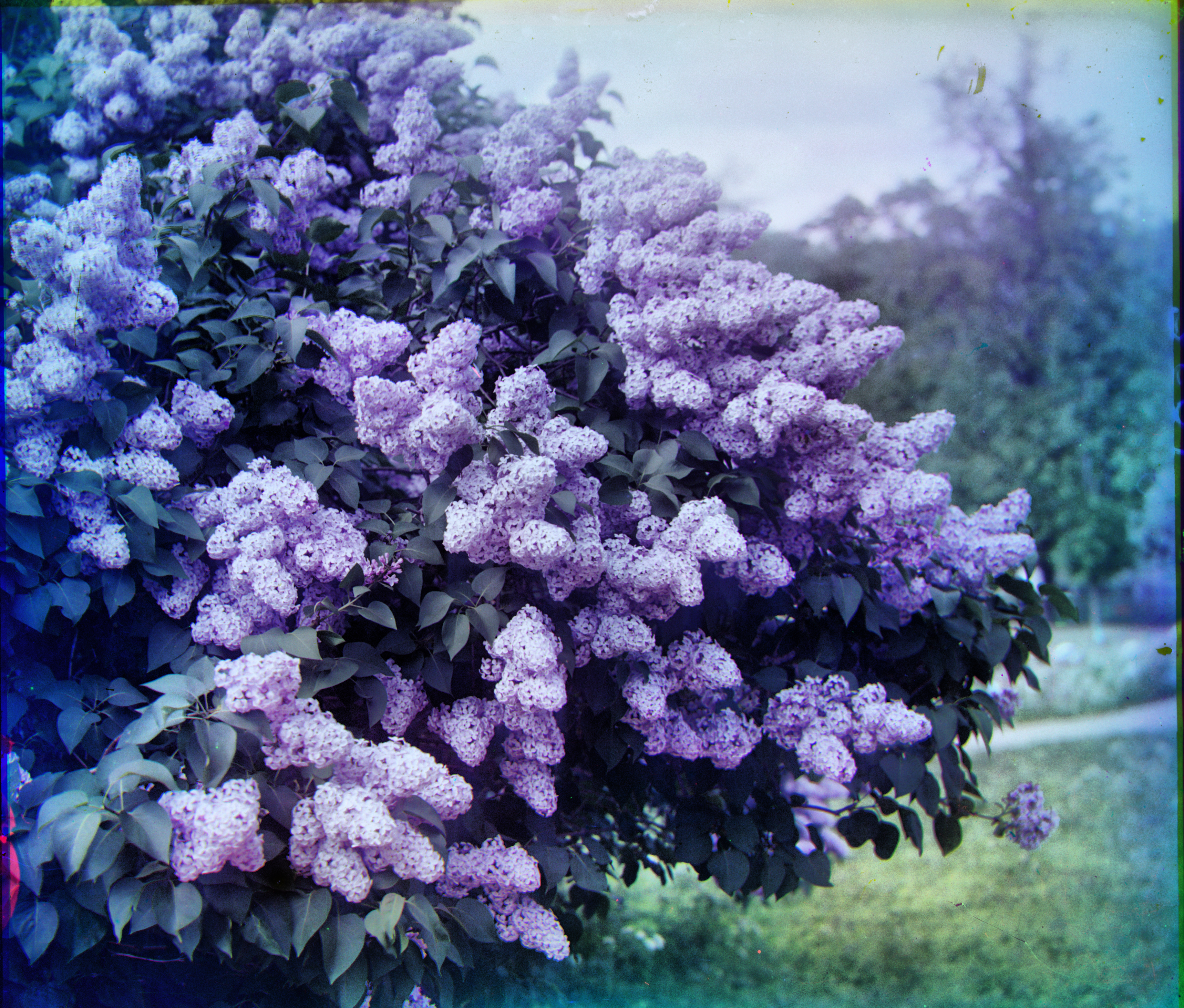
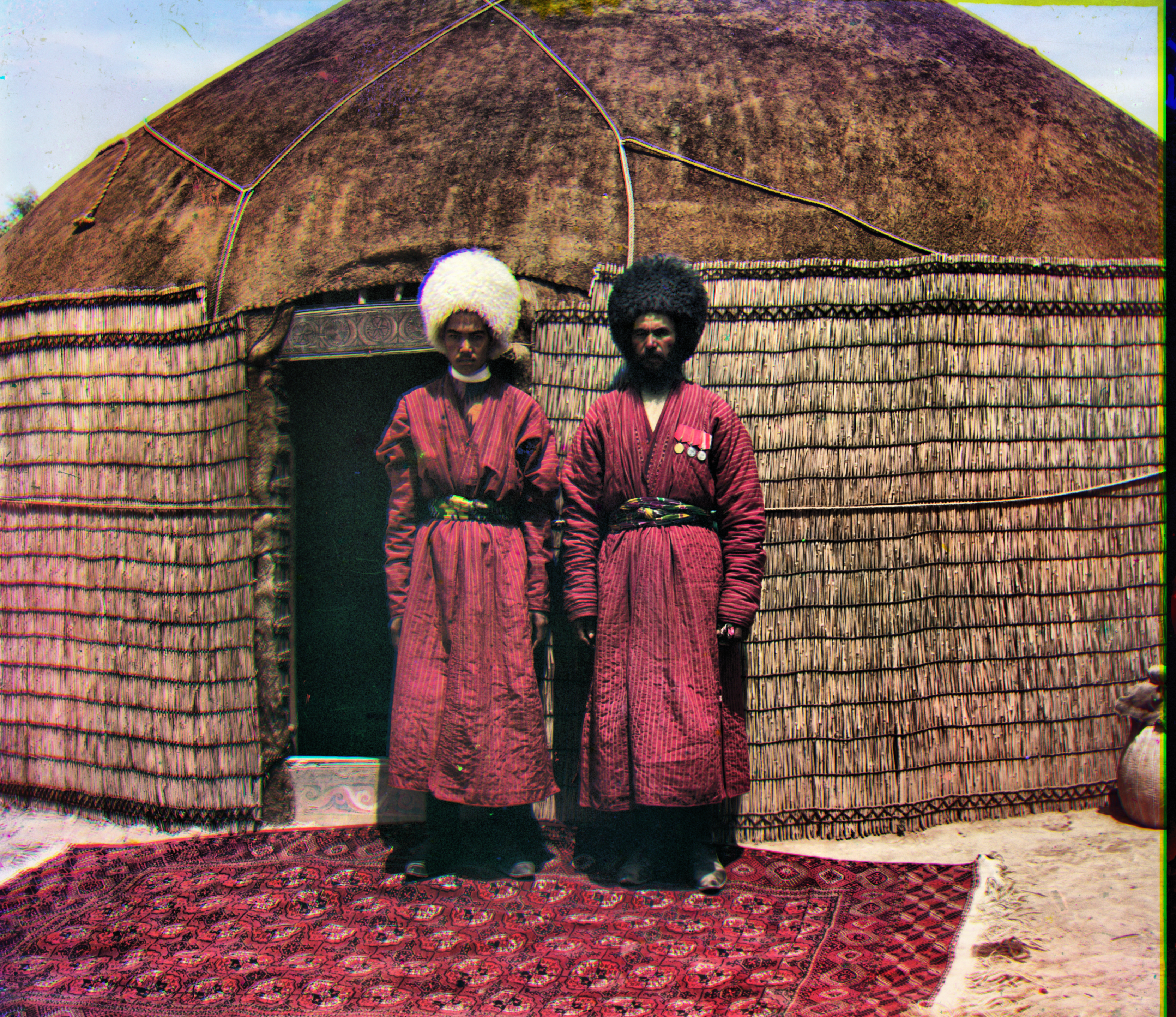
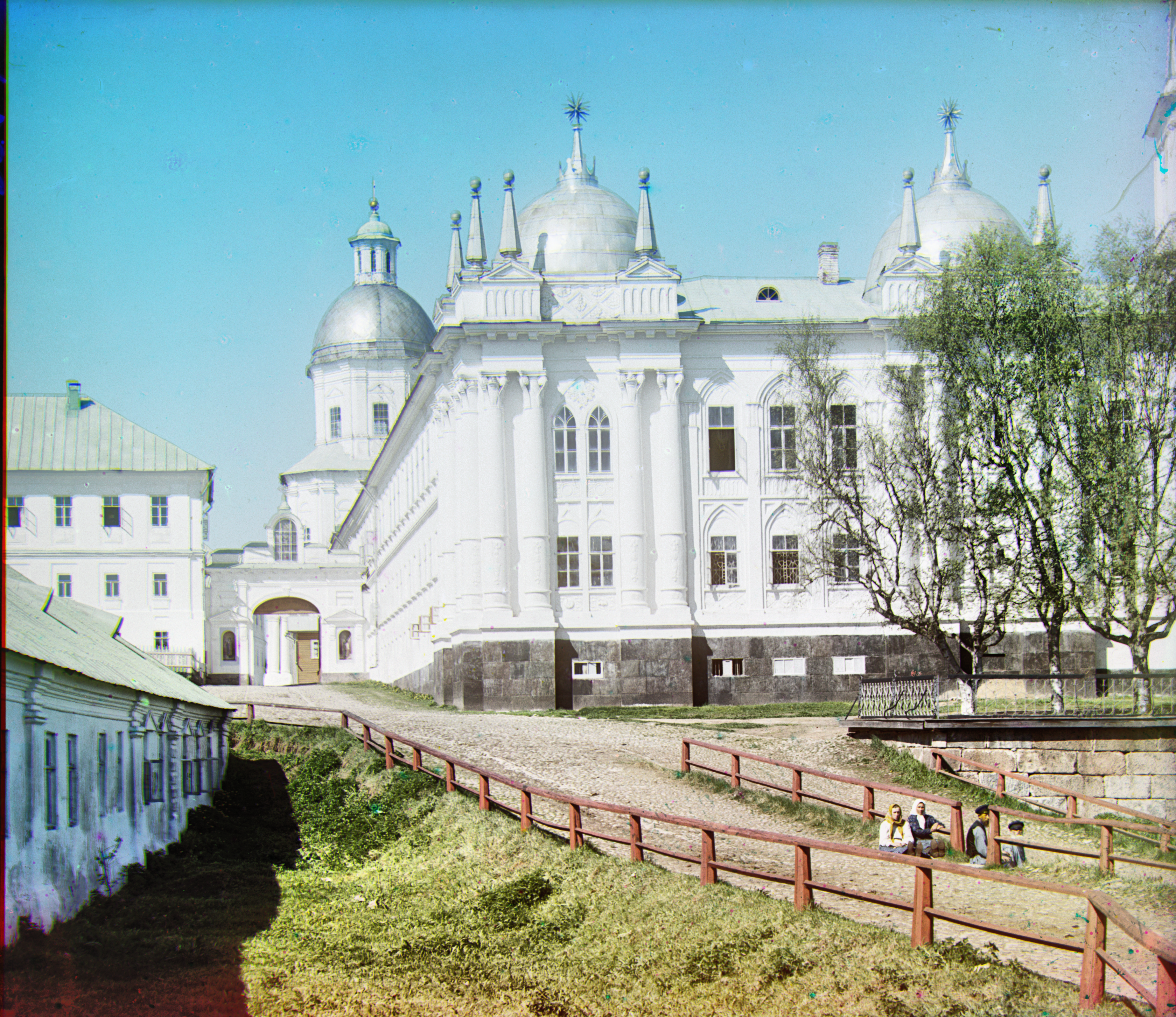
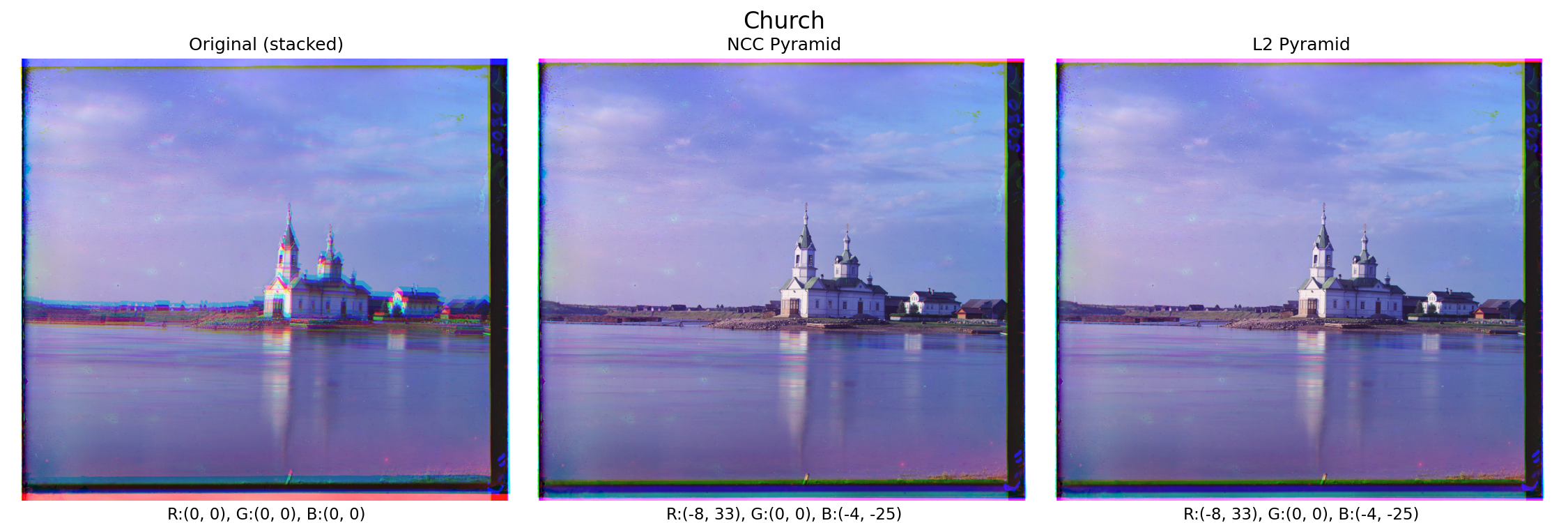
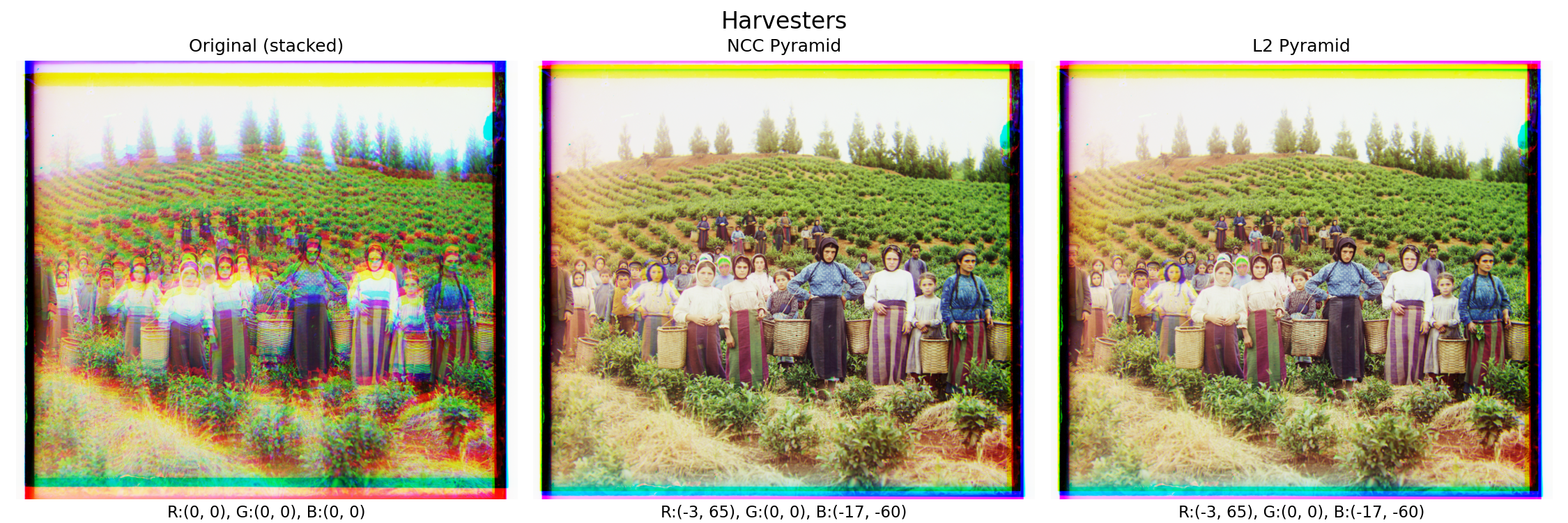
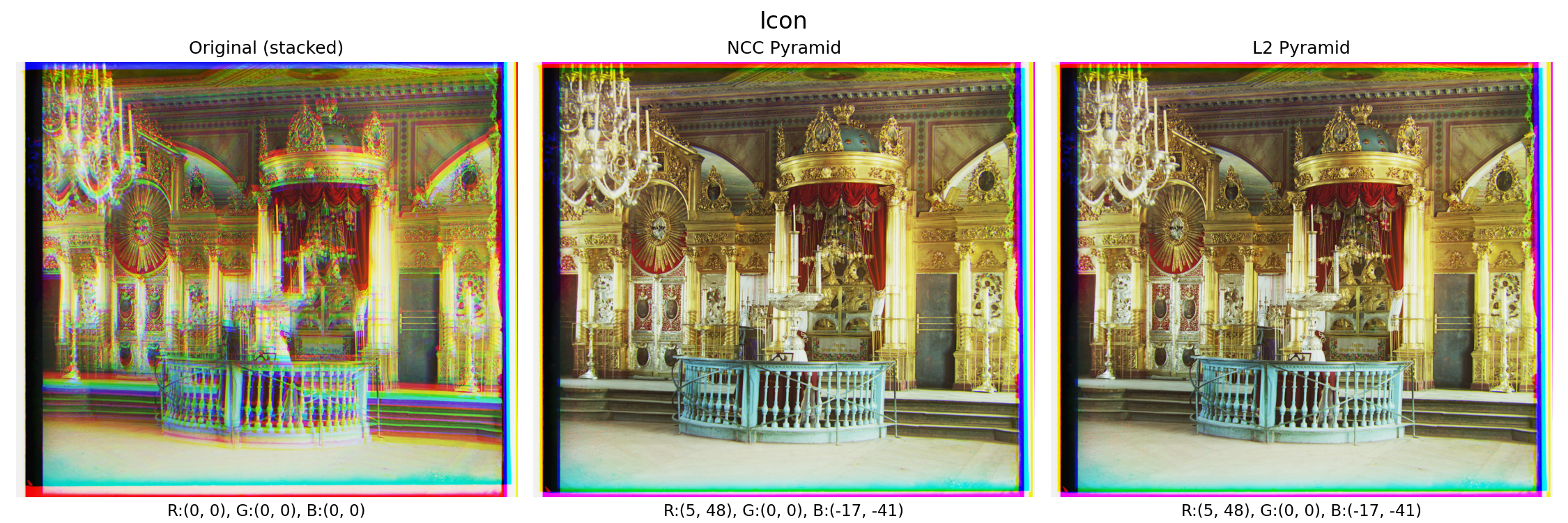
Here are more results from aligning other images from the Prokudin-Gorskii collection.
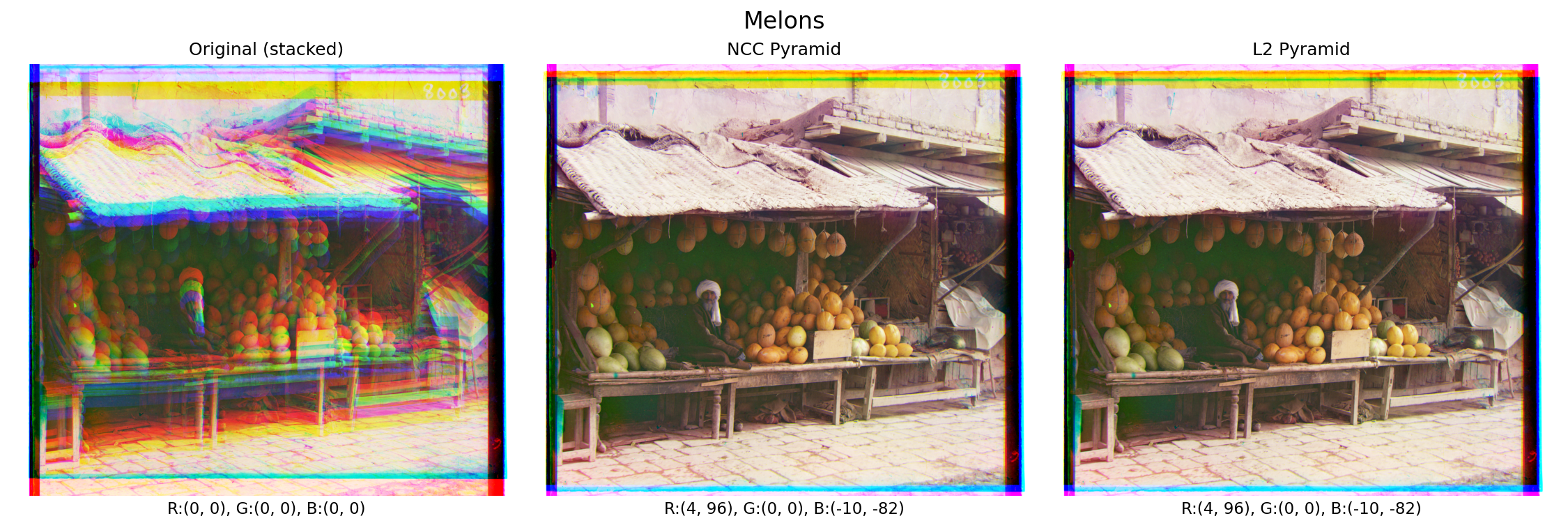
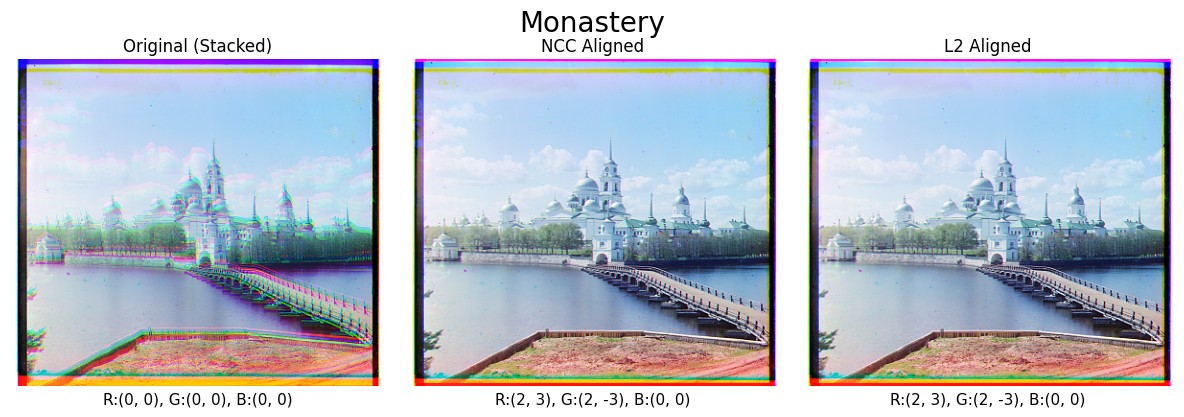
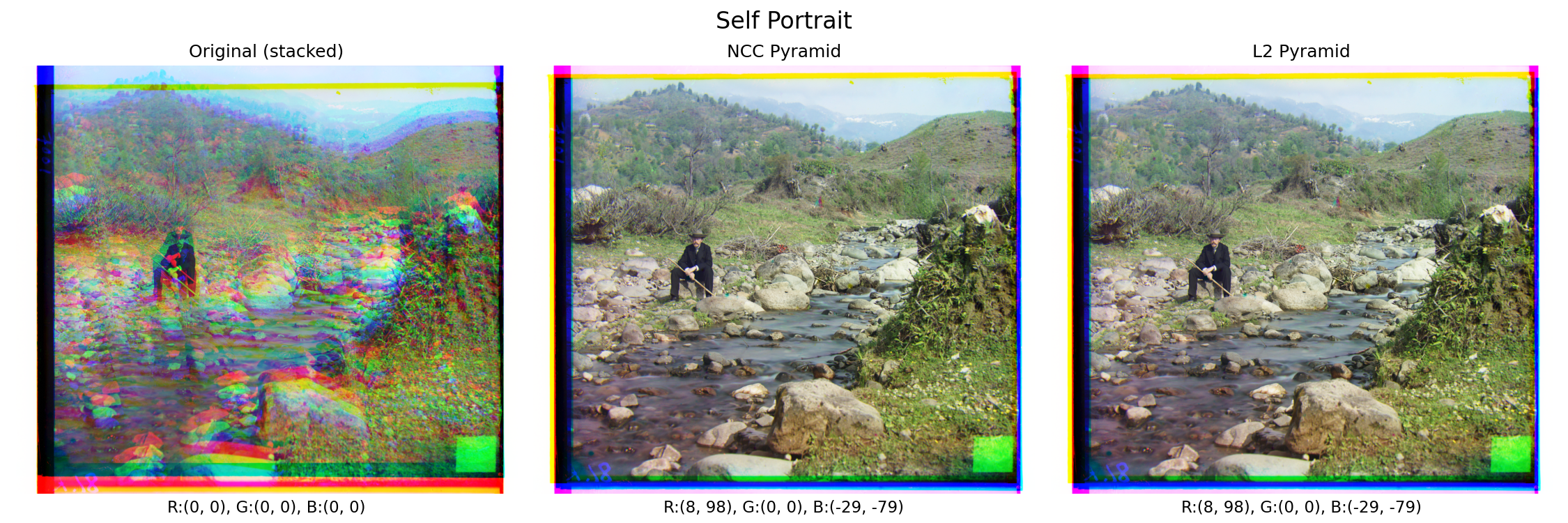
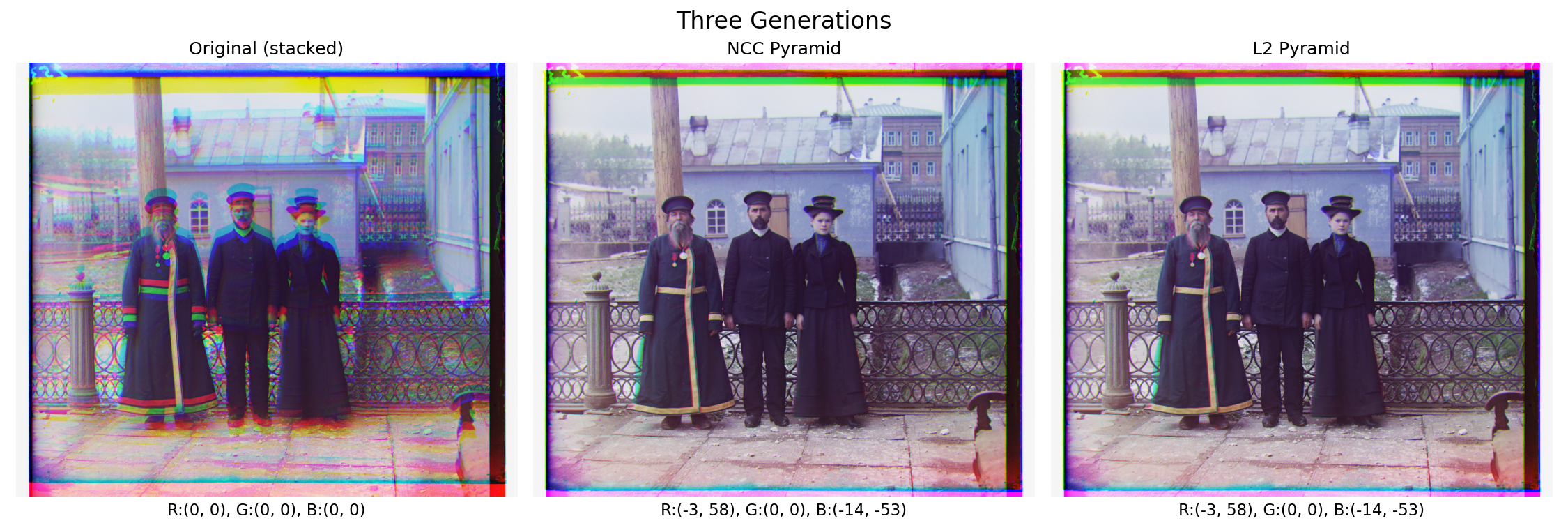
Final Gallery
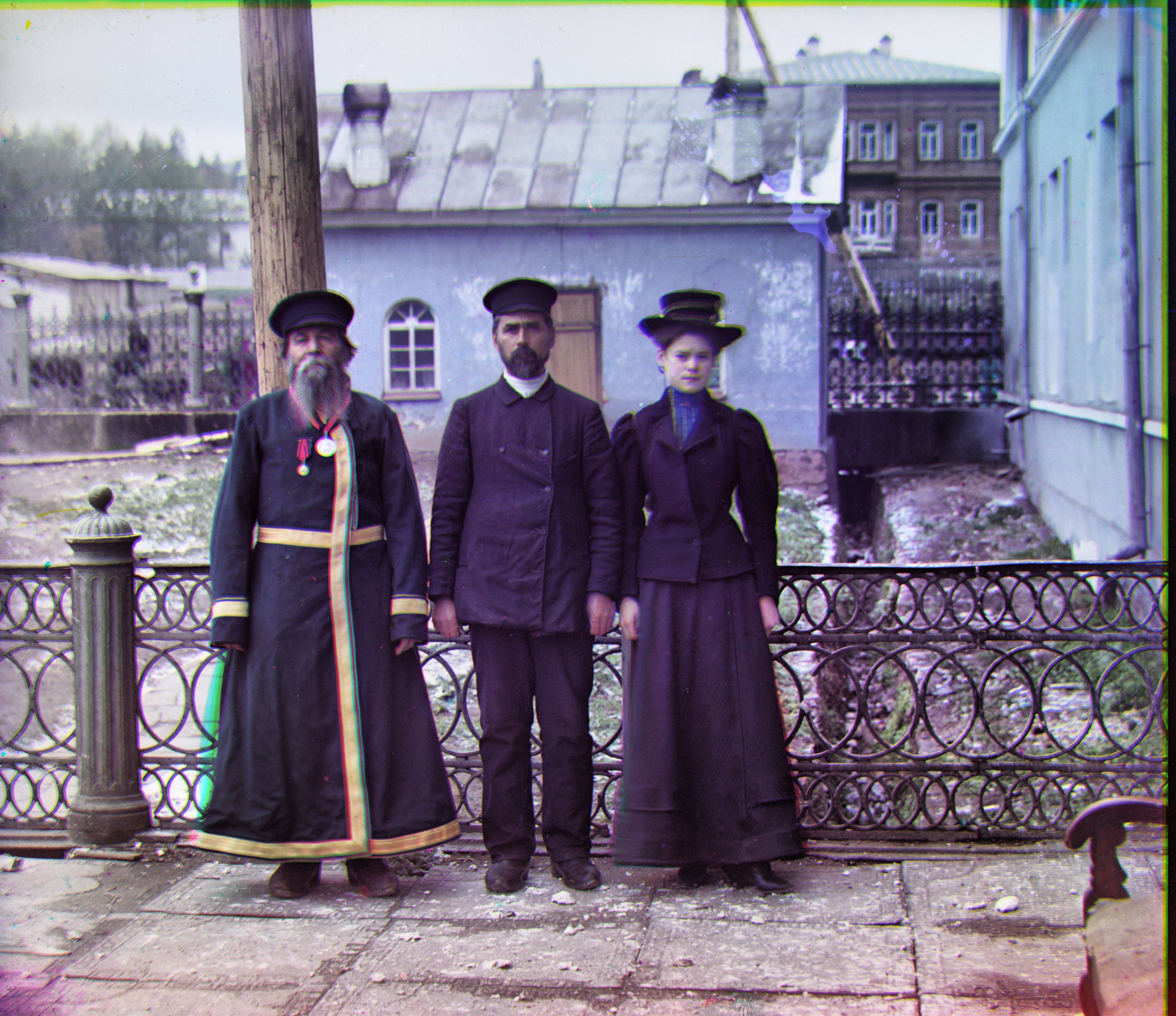
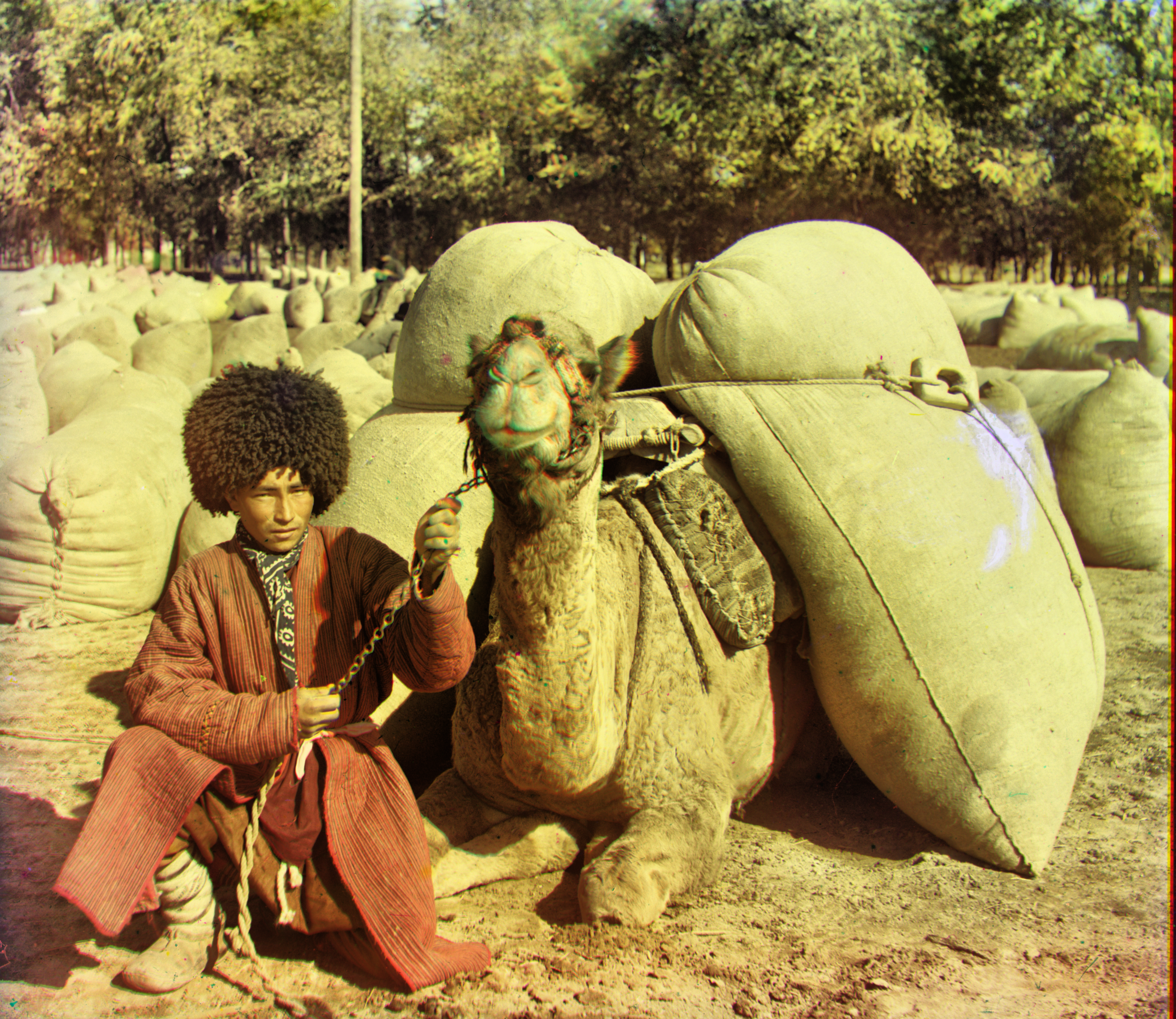
Here are the final, processed images, which have been aligned using the L2 Norm, enhanced with adaptive histogram equalization, and cropped by 5% to remove noisy borders. Histogram equalization is a contrast enhancement technique that redistributes the pixel intensities of an image to be as uniform as possible.